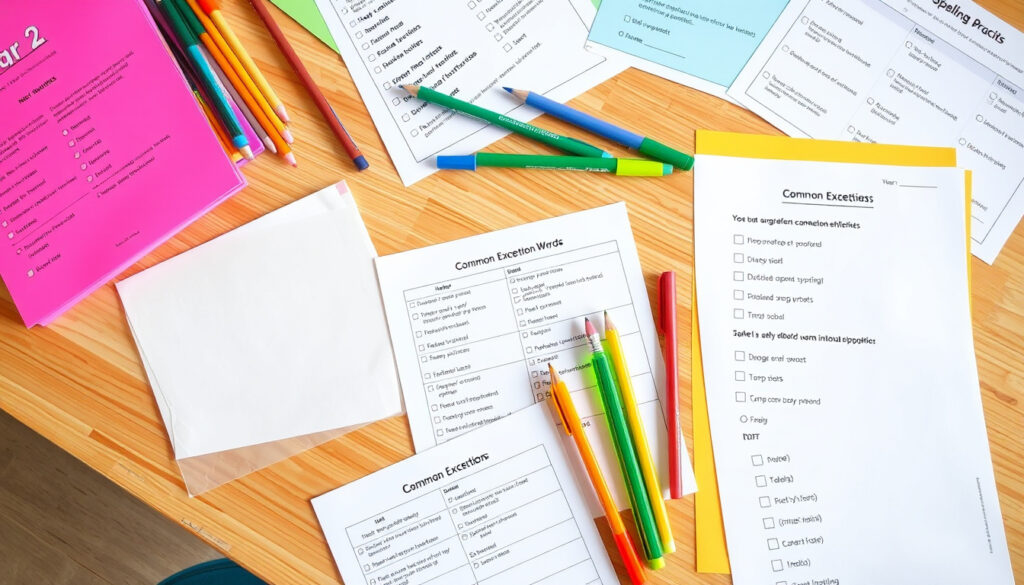
Year 2 Common Exception Words: List, Worksheets & PDF
If your child brings home a spelling list and “sugar” or “climb” suddenly looks like a puzzle, you’re not alone. Year 2 marks the point where the National Curriculum expects children to tackle these irregular spellings head-on—and Oxford Owl’s official list gives parents a clear roadmap for what that looks like in practice.
Target age group: 6-7 years (Year 2) · Key examples: sugar, improve, climb, because · Word count in lists: 55 (Oxford Owl source) · Curriculum focus: UK National Curriculum phonics exceptions · Common resources: worksheets, PDFs, flashcards
Quick snapshot
- 55 irregular words (Oxford Owl)
- Spelling rule exceptions
- Printable PDF available
- Twinkl worksheets
- Oxford Owl activities
- School implementation PDFs
- Year 1 basics
- Year 3/4 advances (100 words)
- Progression path
- Look, Cover, Write, Check
- Phonics-based activities
- Hands-on flashcard practice
The table below summarises the key facts about Year 2 common exception words, drawn from the National Curriculum and UK school implementations.
| Label | Value |
|---|---|
| Definition | Words not following phonetic spelling rules |
| Key examples | sugar, poor, break, eye, because, door, floor |
| Oxford Owl list length | ~55 words |
| Target age group | 6-7 years (Year 2, final KS1 year) |
| Curriculum expectation | Confident spelling by end of Year 2 |
| Year 3/4 comparison | 100 words with homophones and suffixes |
| Homophone focus | 10+ pairs including there/their/they’re |
What are common exception words
Common exception words are irregular words that do not follow normal phonics spelling rules. Children in England are expected to spell them confidently by the end of Year 2 (age 7) (Oxford Owl). Unlike regular words where sounding out works every time, these words require memorisation because the letters break the standard patterns.
Definition and purpose
The National Curriculum identifies common exception words as part of its spelling requirements for primary schools (William Tyndale School). These words appear frequently in reading and writing, which is why children need to recognise and spell them correctly despite their irregular letter patterns. Without memorisation strategies, children would stumble on words like “sugar” (no “sh” sound) or “climb” (silent “b”) every time they encountered them.
Why they matter in Year 2
Year 2 is the final year of Key Stage 1, making it a critical checkpoint for foundational literacy (Twinkl). By this stage, children have exhausted simple phonics decoding and need these irregular words committed to memory. The ability to spell “because” correctly separates competent writers from those still relying on phonetic guessing. Teachers report that mastering exception words builds the confidence children need for the jump to Key Stage 2 writing.
Year 2 common exception words worksheets
Worksheets turn exception word practice from rote memorisation into active learning. Quality resources give children repeated exposure through varied activities, keeping practice engaging without becoming repetitive.
Free printable worksheets
Twinkl offers Year 2 Common Exception Words List resources designed for KS1 children (Twinkl). Their activities follow the “Look, Cover, Write and Check” method—a straightforward cycle that forces children to test themselves rather than passively reading. The worksheets include fill-in-the-blank exercises, word searches, and matching activities that target the tricky letter patterns within each word.
“A fantastic method is the ‘Look, Cover, Write and Check’.”
— Twinkl (Educational Resource Provider)
Twinkl resources include engaging activities centred around Year 2 common exception words, with options for differentiated difficulty levels. Parents can filter by ability, making it straightforward to find worksheets that challenge without frustrating. Colerne School also provides a Year 2 Common Exception Words Checklist PDF with words like door, even, sugar, floor, great, eye, poor, break, and could (Colerne School). Great Staughton School implements Oxford Owl’s list for Spring 1 spellings, focusing weekly on subsets like fast, last, father, class, grass, and pass (Great Staughton School).
Activity ideas
Beyond worksheets, practical activities reinforce exception words through multiple senses. Magnetic letters on the fridge let children rearrange letter patterns physically. Colour-coding the unusual letters within each word (like the silent “b” in “climb”) creates a visual memory hook. Dictation games—where a parent reads a sentence containing exception words—test spelling under slight pressure without the stress of a formal test.
Worksheets work best when paired with real writing. Children who practise exception words only in isolation often fail to transfer the spelling to their own stories. Look for resources that include sentence writing, not just word lists.
Year 2 common exception words pdf
PDF resources give parents and teachers a take-anywhere reference that works offline—no subscription required, no internet dependency for printing. The most useful PDFs combine the word list with practice spaces.
Official PDF lists
Oxford Owl recommends downloading their Year 2 common exception words worksheet for practice (Oxford Owl for Home). Their resources link to the official England National Curriculum list, giving parents confidence they’re working from the right source. The Oxford Owl page provides activity sheets alongside the word list, so practice and reference live in one document.
William Tyndale School publishes a National Curriculum-aligned Year 2 common exception words PDF that explicitly states its source (William Tyndale School). Their list includes door, even, sure, floor, great, and sugar. Kimbolton Primary Academy uses Oxford Owl for Summer 1 spellings, selecting words like any, many, clothes, and water for focused weekly practice (Kimbolton Primary Academy).
“This is a word list taken from the National Curriculum of recommended words a Year 2 child should be confident spelling as they complete Year 2.”
— William Tyndale School (School Administration)
School-provided examples
School PDFs match the Oxford Owl list closely, confirming consistency across UK primary schools (Colerne School). Great Staughton School’s PDF references a CDN upload dated 2019-08-29, giving parents a sense of when the official resources were last refreshed. Colerne School’s checklist PDF groups words thematically—for instance, words with the “oo” sound spelled differently (door, floor, poor)—making patterns easier to spot.
The gap between Oxford Owl’s complete list and school PDFs is intentional. Schools select weekly subsets for focused practice; they don’t expect children to master all 55 words at once. Download the full Oxford list as your reference, then follow your school’s weekly focus for pacing.
Year 2 common exception words Oxford Owl
Oxford Owl serves as the authoritative source for England’s Year 2 exception words. Their list is the one schools reference, the one the National Curriculum aligns to, and the one parents should keep handy.
Oxford Owl specific list
Oxford Owl provides a specific list of Year 2 common exception words including: everybody, even, great, break, steak, pretty, beautiful, after, fast, last, past, father, class, grass, pass, plant, path, bath, hour, move, prove, improve, sure, sugar, eye, could, should, would, who, whole, any, many, clothes, busy, people, water, again, half, money, Mr, Mrs, parents, door, floor, poor, because, find, kind, mind, behind, child, children, wild, climb, most, only, both, old, cold, gold, hold, told, and every (Oxford Owl). That’s approximately 55 words that children should spell confidently before moving to Year 3.
“Here are some common exception words – words that are spelled without using the normal spelling rules – that children in England are expected to be able to spell by the end of Year 2 (age 7).”
— Oxford Owl (Educational Publisher)
Integration with phonics
Oxford Owl integrates exception words within the broader Year 2 spelling curriculum, which also covers homophones like there/their/they’re, here/hear, and see/sea (Oxford Owl for Home). Children learn suffixes like -ment, -ness, -ful, -less, and -ly in Year 2, expanding their toolkit beyond exception words alone. The platform provides activity sheets for joined-up letters alongside spelling practice, connecting handwriting and spelling instruction (Oxford Owl for Home).
Oxford Owl targets children in England specifically for Year 2 exception words—no Scotland, Wales, or Northern Ireland variants appear in their materials. All sources align to the England National Curriculum, so parents in other UK nations should check local requirements.
Year 2 tricky words list
“Tricky words” is the informal term teachers and parents often use for common exception words. Both refer to the same concept: words where standard phonics decoding fails and memorisation takes over.
Full Year 2 list
Lists consistently include words like door, floor, and poor across multiple school PDFs (William Tyndale School). Monster Phonics flashcards offer a visual approach, using monster characters to highlight the unusual letter patterns within each word. Colerne School’s checklist includes words like door, even, sugar, floor, great, eye, poor, break, could, and because—giving parents a concrete example of what a school’s working list looks like (Colerne School).
Year-over-year progression
Year 2 words build on Year 1, focusing on high-frequency tricky words that children encounter daily (Oxford Owl for Home). Year 1 introduces simpler exception words; Year 2 adds complexity and count. By Year 3 and 4, Oxford Owl lists 100 spelling words, including homophones like accept/except and words with suffixes like accident(ally) and actual(ly) (Oxford Owl). Homophones in Year 3/4 expand on the pairs introduced in Year 2, raising the bar for spelling accuracy in increasingly complex writing.
How to teach Year 2 common exception words
Effective teaching combines repetition with engagement. Children need to encounter these words often and in context, not just on isolated word lists.
- Step 1 — Show the word and say it aloud. Pronunciation matters because some exception words sound different from their spelling. Say “sugar” clearly so children notice the “sh” sound isn’t spelled with “sh”.
- Step 2 — Look for the tricky part. Ask children to circle or highlight the letter (or letters) that don’t match the sound. In “climb,” it’s the silent “b”. In “because,” it’s the whole word.
- Step 3 — Cover and trace. Use the Look, Cover, Write, Check method: look at the word for 5 seconds, cover it, write from memory, then check against the original (Twinkl).
- Step 4 — Use in a sentence. Seeing the word in context cements both spelling and meaning. Dictate sentences like “I climbed the tree” to connect the written word to a real situation.
- Step 5 — Revisit regularly. Spacing matters. Revisit previously learned words every few days alongside new ones to prevent forgetting.
Children who learn exception words only through spelling tests often forget them by the next term. Consistent short practice—5 minutes daily—beats cramming before a test. Parents who keep a running list on the fridge or in a notebook see better retention than those who treat exception words as a one-off homework assignment.
Year 2 vs Year 1 and Year 3/4
Understanding how Year 2 fits into the broader spelling progression helps parents pace learning appropriately and avoid either pressure or gaps.
The comparison below shows how word counts and focus areas shift across the primary years.
| Year Group | Word Count | Focus | Example Words |
|---|---|---|---|
| Year 1 | ~30 words | Basic high-frequency tricky words | said, so, have, like, the, she |
| Year 2 | ~55 words | Advanced exceptions, homophones, suffixes | sugar, climb, because, there, -ment, -ness |
| Year 3/4 | ~100 words | Complex homophones, Greek/Latin roots | accept/except, accident, believe |
The implication: Year 2 sits at a critical transition point. Children who enter Year 2 without solid Year 1 foundations often struggle with the jump to 55 words. Conversely, children who master Year 2 words find Year 3/4’s 100-word list daunting mainly in volume, not in concept. Parents should check whether their child has confident recall of Year 1 exception words before assuming Year 2 words will land easily.
Confirmed facts
- Oxford Owl provides ~55 Year 2 exception words
- Children aged 6-7 (Year 2) are expected to spell them by end of year
- Schools consistently match Oxford Owl’s list
- Twinkl and school PDFs offer free practice resources
- Look, Cover, Write, Check is the standard teaching method
What’s unclear
- Exact publication date for Oxford Owl’s current list (last CDN reference: 2019-08-29)
- Whether Scotland, Wales, and Northern Ireland have formally diverged from England’s list
Summary
For parents of Year 2 children, the path forward is straightforward: grab Oxford Owl’s official list as your reference, follow your school’s weekly spelling focus for pacing, and practise using Look, Cover, Write, Check alongside sentence writing. The 55 words are learnable with consistent short sessions—no genius required, just repetition. Children who master these exception words enter Key Stage 2 with clean writing mechanics, ready to focus on ideas rather than spelling brick walls. Those who skip the groundwork will hit the same walls when Year 3/4 adds 100 more exception words to the pile.
Related reading: How to Play Chess · 7 Habits of Highly Effective People
greatstaughton.cambs.sch.uk, kimboltonprimaryacademy.cambs.sch.uk, twinkl.com, colerneschool.com, williamtyndale-islington.co.uk, oxfordowl.co.uk, scribd.com, oxfordowl.co.uk, home.oxfordowl.co.uk
Frequently asked questions
How many Year 2 common exception words are there?
Oxford Owl’s official Year 2 list contains approximately 55 words. Schools often work through these in weekly subsets rather than all at once.
What is the difference between tricky words and common exception words?
Nothing—these are two names for the same thing. “Common exception words” is the formal National Curriculum term; “tricky words” is the classroom-friendly version used with young children.
Are there free Year 2 common exception words flashcards?
Yes. Monster Phonics and Twinkl offer printable flashcards, and several UK primary schools publish free checklist PDFs (including Colerne School and William Tyndale School) that work well as flashcard material.
How to teach Year 2 common exception words?
Use the Look, Cover, Write, Check method: show the word, have children trace the tricky letter patterns, cover the word, write from memory, then check. Combine this with dictation in real sentences for best retention.
Where to download the Year 2 common exception words list?
Oxford Owl offers the official list on their website, and UK schools like William Tyndale School and Colerne School publish free PDF checklists aligned to it.
Do Year 2 words overlap with Year 1?
Yes. Year 2 words build on Year 1 basics. If your child struggles with Year 2 exception words, revisit Year 1 words first—solid foundations prevent compounding gaps.
How does the Year 2 list compare to Year 3/4?
Year 2 has roughly 55 words focused on high-frequency irregular spellings. Year 3/4 expands to about 100 words, adding complex homophones and suffix patterns. Children who master Year 2 words find Year 3/4 manageable mainly in volume.
More related posts
 Gordon Ramsay Net Worth – $220 Million in 2026
 Kim Jong Un: Biography, Family, and Rule of North Korea’s Leader
 Everton vs Mansfield Town – 2-0 Carabao Cup Match Report
 B&M Bargains: Discount Shopping Guide, Stores & Opening Hours
 Lanzarote Floods Costa Teguise – Latest Updates Hotel Closures Impacts
 When is the Ryder Cup 2025? Dates, Venue, TV Schedule & Teams
 BrewDog Beers Axed by Nearly 2000 Pubs: Reasons Revealed
 Jack Champion: Age, Movies & Sigourney Weaver Kiss Rumor