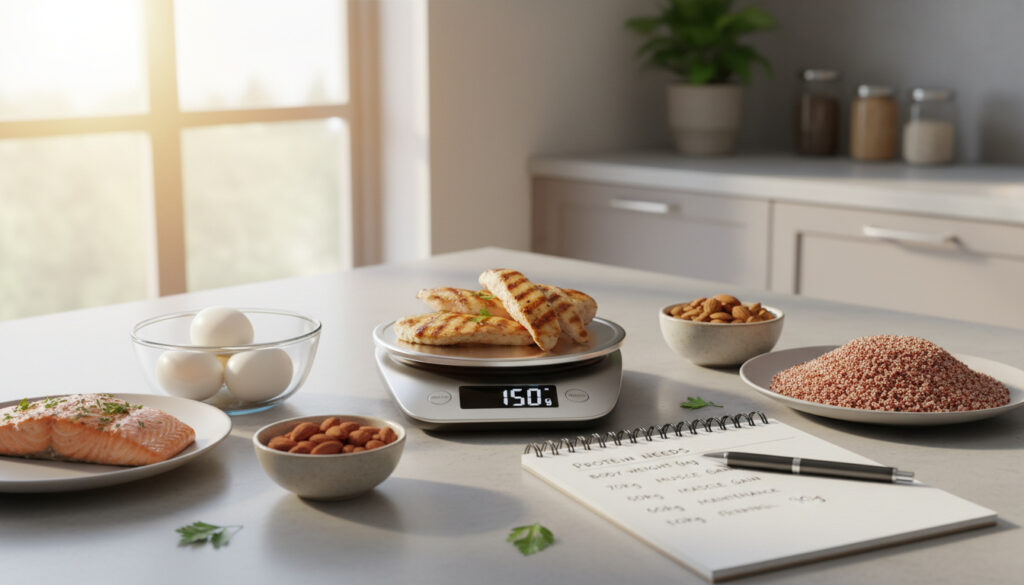
How Much Protein Should I Eat – Daily Needs by Weight and Goals
Protein serves as the fundamental building block for muscle, enzymes, and hormones, yet daily requirements remain one of the most debated topics in nutrition. While official guidelines establish baseline minimums, individual needs diverge sharply based on body composition, activity levels, and age.
The gap between preventing deficiency and optimizing performance spans nearly threefold. Sedentary adults require substantially less than strength athletes, while weight loss goals and aging introduce additional variables that standard recommendations fail to capture.
Determining precise targets requires translating meta-analytic research into practical intake ranges for diverse populations and objectives.
How Much Protein Do I Need Per Day?
Prevents deficiency in sedentary adults
Supports regular training and metabolic health
Optimal for hypertrophy and strength gains
Maximum for healthy kidneys during deficit
- The Recommended Dietary Allowance (RDA) of 0.8 grams per kilogram prevents protein deficiency in inactive adults but proves insufficient for muscle maintenance or growth.
- Meta-analyses of 49 studies involving 1,863 participants establish 1.6 g/kg as the mean optimal intake for muscle building, with benefits extending to 2.2 g/kg for most individuals.
- Women require the same gram-per-kilogram ratios as men, adjusted only for typically lower body weights, with no gender-specific RDA modifications indicated.
- Older adults demonstrate heightened anabolic resistance, necessitating intake at the higher end of recommendations (2.0–2.2 g/kg) to stimulate muscle protein synthesis.
- Healthy kidneys tolerate protein intakes up to 2.2–2.7 g/kg without documented adverse effects, though excess beyond muscle-building needs serves primarily to increase satiety.
- Plant-based eaters can achieve equivalent totals through strategic food combining, though some evidence suggests requiring 10–20% additional intake to compensate for lower digestibility.
| Population | g/kg Body Weight | Example (70kg/154lb) |
|---|---|---|
| Sedentary Adult | 0.8 g/kg | 56g daily |
| Moderate Activity | 1.2 g/kg | 84g daily |
| Weight Loss Focus | 1.6 g/kg | 112g daily |
| Muscle Building | 2.0 g/kg | 140g daily |
| Older Adults (65+) | 2.2 g/kg | 154g daily |
| Elite Athletes | 2.2 g/kg | 154g daily |
How Do I Calculate My Protein Needs?
Calculations require converting pounds to kilograms using the factor 0.4536, then multiplying by your target gram-per-kilogram ratio. For a 68 kg person, the RDA equals approximately 55 grams, while muscle-building goals demand 109–150 grams depending on training intensity.
Converting Weight and Basic Math
Multiply body weight in pounds by 0.4536 to obtain kilograms. Then multiply by your target grams per kilogram based on activity level. A 150-pound individual (68 kg) requires 54 grams for basic health but 109–150 grams for hypertrophy.
Digital Calculators and Tools
Specialized calculators automate these computations. Tools from StrengthLog, ATHLEAN-X, and Ro adjust for training frequency, caloric status, and age. Calculator.net provides additional mathematical verification.
Input your exact weight, weekly training hours, and primary goal (maintenance, fat loss, or muscle gain) into verified calculators to receive personalized gram targets rather than estimating from generic tables.
How Much Protein for Building Muscle or Weight Loss?
Hypertrophy and Strength Gains
Research synthesized from 49 studies indicates maximum muscle accretion occurs at 1.6 g/kg mean intake, extending to 2.2 g/kg for 97.5% of populations. Participants consuming 1.6 g/kg gained approximately 300 grams additional fat-free mass while losing 400 grams of fat over three months compared to those consuming 1.4 g/kg.
Caloric Deficits and Body Composition
Weight loss protocols recommend 1.2–1.6 g/kg to preserve lean tissue during energy restriction. Lean individuals or those utilizing GLP-1 medications may require up to 2.7 g/kg to prevent catabolism. Protein typically comprises 15–25% of total calories during cutting phases.
Protein Needs by Age, Activity, and Demographics
Older Adults and Anabolic Resistance
Individuals over 65 require 2.0–2.2 g/kg when combined with resistance training to overcome reduced muscle protein synthesis sensitivity. This higher threshold counters sarcopenia and functional decline.
Plant-Based and Vegan Considerations
Vegan athletes achieve comparable results through complete protein combinations such as soy, pea, and rice blends. Evidence suggests requiring 10–20% higher total intake due to reduced digestibility, though meta-analyses confirm efficacy when utilizing leucine-rich supplements.
Women and men utilize identical gram-per-kilogram ratios, though Legion Athletics and Hims note that older populations benefit specifically from the upper ranges regardless of gender.
Risks of Too Much Protein and Best Sources
Kidney Health and Safety Limits
Current evidence indicates intakes up to 2.2–2.7 g/kg present no risk for individuals with healthy renal function. No data suggests protein overload at recommended athletic intakes, though excess beyond muscle-building requirements converts primarily to satiety signals rather than additional tissue.
Whole Foods Versus Supplements
Whole food sources provide micronutrients alongside amino acids. Whey protein delivers effective 30-gram post-workout doses, while plant-based alternatives match efficacy when fortified with leucine. Supplement calculators serve as practical tools for reaching 1.6+ g/kg targets rather than dietary replacements.
Individuals with pre-existing kidney disease should consult healthcare providers before exceeding the RDA, as research on high-protein diets in compromised renal function remains limited in the current meta-analytic literature.
How Has Protein Guidance Changed Over Time?
- : Initial protein Recommended Dietary Allowance established based on early nitrogen balance studies.
- : Standard updated to 0.8 g/kg body weight for general adult health, remaining the current RDA baseline.
- : International Society of Sports Nutrition (ISSN) formalizes athlete-specific recommendations exceeding standard guidelines.
- : Meta-analysis confirms 1.6 g/kg threshold for muscle building in adults under 65, validating higher intake ranges.
What Do We Know for Certain About Protein Intake?
| Established Evidence | Remaining Uncertainties |
|---|---|
| RDA of 0.8 g/kg prevents deficiency in sedentary adults | Long-term metabolic effects of sustained intakes exceeding 3.0 g/kg |
| 1.6–2.2 g/kg optimizes muscle hypertrophy with training | Optimal distribution timing across daily meals |
| Healthy kidneys tolerate up to 2.7 g/kg without damage | Individual genetic variations in protein utilization |
| Higher intake protects muscle during caloric deficit | Interaction effects with specific medication classes |
Why Do Individual Protein Requirements Vary?
Body composition, training status, and age create a spectrum of needs. An elite strength athlete requires substantially more than an office worker to repair exercise-induced muscle damage. Similarly, aging reduces the efficiency of protein utilization, necessitating higher absolute intakes to maintain equivalent synthetic responses.
Commercial availability influences dietary patterns significantly. Chick-fil-A UK – Locations, Menu and Expansion Plans illustrates how regional food accessibility impacts high-protein meal options for consumers tracking macros.
What Do the Research Reviews Conclude?
Meta-analytic evidence supports protein intakes of 1.6 g/kg/day for maximizing muscle hypertrophy and strength in resistance-trained individuals, with potential benefits extending to 2.2 g/kg for those seeking to optimize body composition.
International Society of Sports Nutrition, 2020 Analysis
The 2022 meta-analysis confirmed that intakes at or above 1.6 g/kg produce significant muscle building outcomes in adults under 65 years when combined with progressive resistance training.
Clinical Research Synthesis, 2022
How Should You Apply These Protein Guidelines?
Aim for 0.8 g/kg if sedentary, 1.6 g/kg when training for muscle, and 2.0+ g/kg if over 65 or in aggressive deficit. Track intake for two weeks to establish baselines, then adjust based on recovery and body composition changes. Community health resources remain valuable for ongoing monitoring; British Heart Foundation Near Me – Find Shops, Locations and Hours offers nutritional guidance alongside cardiovascular health services.
Frequently Asked Questions
Is 100g of protein enough?
For a 70kg person, 100g provides 1.43 g/kg, sufficient for maintenance but below optimal muscle-building targets. Heavier or active individuals require more.
Are protein shakes necessary?
Not mandatory, but practical for reaching 1.6+ g/kg targets. Whole foods provide equivalent amino acids when portions align with macro goals.
What happens if I eat too much protein?
Excess up to 2.7 g/kg poses no risk for healthy kidneys. Beyond muscle-building needs, extra protein primarily increases satiety without additional tissue gain.
How much protein should come from supplements versus food?
Prioritize whole foods for micronutrients, using supplements for 30g post-workout or to fill gaps. No specific ratio required if totals meet daily targets.
Do vegans need different protein amounts?
Vegans can achieve identical totals using soy, pea, or rice proteins. Some evidence suggests 10–20% higher intake due to digestibility differences.
More related posts
 Is COVID Still Around – UK Rates, Risks and Trends 2026
 How Many Goals Has Ronaldo Scored – Career Total and Breakdown
 Year 2 Common Exception Words: List, Worksheets & PDF
 Chicken Run Dawn of the Nugget: Sequel, Cast, Reviews
 Nike Air Force 1 Black: Men’s, Women’s, Junior Ireland Guide
 Cast of It Ends with Us – Full Cast List and Key Roles
 HMV Comeback UK Stores – Where and When They’re Opening
 When Is the Next Sale 2025 – Black Friday November 28