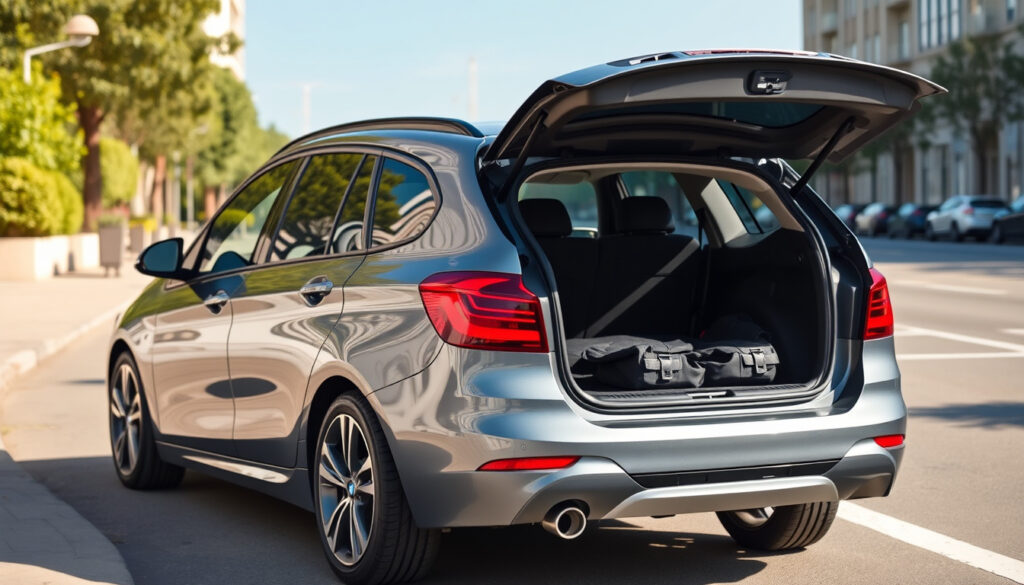
BMW 2 Series Active Tourer – Price, Specs, Boot Space & Reviews
The BMW 2 Series Active Tourer sits in a quietly practical corner of the BMW lineup — a five-seat premium MPV that prioritises family space over driving fireworks. Available with petrol, diesel, and plug-in hybrid powertrains, it competes directly against the Mercedes B-Class, Audi Q2, and Volkswagen Golf, offering a notably more upmarket cabin than most rivals at a similar footprint.
Boot capacities range from 406 litres in PHEV guise up to 470 litres in the diesel variant with seats in place, extending to between 1,370 and 1,455 litres when the rear seats are folded. The plug-in hybrid models account for an expected half of all sales, according to Top Gear’s review, underlining how central electrification is to the car’s appeal.
Widely regarded as an excellent family hauler rather than a driver’s car, the Active Tourer is designed for people who need practicality wrapped in BMW quality. It is not offered as a seven-seater — that role belongs to the larger Gran Tourer sibling.
What Is the BMW 2 Series Active Tourer Price, and Where Can You Buy One?
5-seat premium MPV, front-wheel or all-wheel drive options
Petrol (220i/223i), diesel (218d), and plug-in hybrid (225e, 230e xDrive)
225e PHEV listed at €61,854 in European markets; UK-specific pricing not confirmed in available sources
Described as among the best in class due to premium badge and low running costs when charged regularly
- UK-specific new car prices are not detailed in available sources; a European market figure of €61,854 applies to the 225e PHEV.
- Strong residual values are linked to BMW’s premium positioning, potentially reducing whole-life ownership costs versus less prestigious rivals.
- The used market for the current generation is growing; the prior-generation 225xe offered a more modest 25–34 mile electric range by comparison.
- PHEVs kept regularly charged deliver especially low running costs on short daily trips, making them attractive lease and company car choices.
- Buyers looking at used examples should verify which generation they are viewing — the newer model carries significantly improved electric range and a floor-integrated battery layout.
- When assessing any used Active Tourer, understanding the vehicle’s history is important; buyers should familiarise themselves with categories such as Category N Car Meaning if a car has a recorded insurance marker.
| Feature | Details |
|---|---|
| Vehicle type | Premium MPV (5-seat) |
| Seating capacity | 5 (no 7-seat Active Tourer option) |
| Available powertrains | Petrol, diesel, plug-in hybrid |
| European PHEV price reference | €61,854 (225e) |
| Resale value rating | Among the best in class (premium segment) |
| Prior-gen PHEV electric range | 25–34 miles (225xe) |
| Current-gen PHEV electric range | Up to 57 miles WLTP (225e/230e) |
| Key UK rivals | Mercedes B-Class, Audi Q2, Volkswagen Golf |
BMW 2 Series Active Tourer Specs: Seating, Interior, Boot Space, and Hybrid Options
Seating is a straightforward five-seat arrangement. The rear bench is wide enough for three adults and comes with ISOFIX anchor points, a fold-down armrest with cupholders, and generous head- and knee-room even for taller occupants. Child seat installation is described as notably easy in multiple reviews, according to Carwow’s full assessment.
A common question concerns seven-seat availability. The Active Tourer does not offer a seven-seat configuration — that is exclusive to the larger 2 Series Gran Tourer, which is a distinct model.
Interior Quality and Cabin Space
The cabin quality sits at a premium SUV level. The front and rear offer ample room for tall occupants, and the wide cabin avoids the cramped feel common in some competitors. Equipment levels are described as class-leading, though the interior design is considered practical rather than visually exciting.
Rear passengers benefit from a sliding and tilting rear bench that can add up to 90 litres of additional flexibility depending on configuration — a useful feature for balancing legroom against luggage needs, as highlighted by Vanarama’s 2022 review.
The 40/20/40 split-folding rear bench slides and tilts, offering up to 90 additional litres of boot space when passengers push the seat forward. A low load lip and boot hooks add to everyday practicality.
Boot Space by Variant
Boot capacity varies meaningfully by powertrain. The diesel 218d offers the most space at 470 litres with seats up and 1,455 litres folded. Petrol models sit in the middle at 415 litres and 1,405 litres respectively. PHEV variants (225e and 230e) carry the smallest load area at 406 litres seats-up and 1,370 litres folded, a direct result of the battery pack occupying underfloor space.
| Model | Boot (Seats Up) | Boot (Seats Folded) |
|---|---|---|
| 218d diesel | 470 L | 1,455 L |
| 220i / 223i petrol | 415 L | 1,405 L |
| 225e / 230e PHEV | 406 L | 1,370 L |
For context, the Skoda Karoq offers 521 litres seats-up, and the Mercedes B-Class reaches 1,505 litres folded — both figures ahead of the Active Tourer’s best. The Active Tourer does, however, comfortably beat the Volkswagen Golf’s boot.
Plug-in Hybrid Powertrain in Detail
The 225e combines a 136 hp 1.5-litre three-cylinder petrol engine with a 109 hp electric motor, producing a combined 245 hp. The 0–100 km/h sprint takes 6.7 seconds. Top speed is rated at 195 km/h. WLTP fuel consumption sits at just 0.6–0.8 L/100 km combined, with CO2 emissions of 14–19 g/km, according to this detailed video review.
The 230e xDrive upgrades power to 326 hp and adds all-wheel drive. Both PHEV variants share a 16.3 kWh gross battery that accepts up to 7.4 kW charging, supporting up to 57 miles of WLTP electric range on the 225e and up to 57 miles on the 230e as well. The battery is now integrated into the floor rather than beneath the seats, recovering cabin space lost in the previous generation.
In the current generation, the battery pack sits within the floor structure rather than under the rear seats, meaningfully improving rear cabin space compared to the older model while reducing — but not eliminating — underfloor storage in the boot area.
| Model | Power | 0–62 mph | Electric Range (WLTP) |
|---|---|---|---|
| 225e PHEV | 245 hp | 6.7 sec (0–100 km/h) | Up to 57 miles |
| 230e xDrive PHEV | 326 hp | Not specified in sources | Up to 57 miles |
| 218d diesel | Not detailed | 8.1 sec (0–60 mph) | N/A |
| 220i / 223i petrol | Not detailed | 5.5–8.1 sec (0–60 mph) | N/A |
WLTP figures for PHEV electric range are measured under controlled conditions. Real-world range will vary depending on driving style, temperature, speed, and battery state of charge. Motorway driving in particular will reduce the quoted figures noticeably.
What Are the Common BMW 2 Series Active Tourer Problems?
No widespread mechanical reliability failures have been flagged across the reviewed sources. The issues identified are largely trade-offs inherent to the car’s design rather than faults in the traditional sense.
The PHEV variants lose underfloor boot storage due to the battery pack and associated cables, which must be stowed somewhere. Reviewers at Solent Renegades and elsewhere note this as a real-world inconvenience rather than a defect. The added weight of the hybrid system also dulls handling compared with the non-hybrid versions.
The diesel 218d has been noted as noticeably noisy, which sits awkwardly against the premium positioning of the rest of the car. Handling across all variants is better than most MPVs but noticeably softer than the BMW X1, which shares some underpinnings.
- PHEV underfloor storage reduced by battery and charging cables
- Hybrid system weight marginally softens handling versus petrol/diesel variants
- 218d diesel engine noise inconsistent with premium brand expectations
- Real-world electric range may fall short of WLTP headline figures
- Handling, while above MPV average, does not match BMW’s own X1 crossover
Buyers of used examples should check whether the vehicle carries any insurance write-off history. Understanding classifications such as What Does Cat N Mean is worthwhile before committing to a purchase, particularly as PHEV components can be costly to repair.
BMW 2 Series Active Tourer vs Gran Tourer: What Are the Key Differences?
The Gran Tourer is the longer-wheelbase sibling to the Active Tourer, offering an optional third row of seats for up to seven occupants. This is the only route to a seven-seat BMW in the 2 Series range — no Active Tourer configuration provides this.
In boot space terms, the Gran Tourer reaches a maximum of 1,510 litres with seats folded, compared to the Active Tourer’s range of 1,370–1,455 litres depending on engine. On pure practicality, the Gran Tourer holds an advantage for larger families.
The Active Tourer, however, is the more modern product in terms of PHEV technology. The current generation carries the floor-integrated battery pack and up-to-57-mile electric range that the Gran Tourer does not match. For buyers prioritising electrification and urban efficiency over maximum people-carrying capacity, the Active Tourer makes the stronger case.
| Attribute | Active Tourer | Gran Tourer |
|---|---|---|
| Maximum seating | 5 | 7 (optional third row) |
| Max boot (seats folded) | 1,370–1,455 L | 1,510 L |
| Modern PHEV tech | Yes — up to 57 miles electric | Less advanced per reviewed sources |
| Primary appeal | Efficiency, family practicality, PHEV | Space, 7-seat flexibility |
How Has the BMW 2 Series Active Tourer Evolved Over Time?
- — First generation (F45) launched, introducing front-wheel drive to BMW’s mainstream lineup for the first time in the modern era.
- — Mid-cycle updates to the F45 generation, including revised infotainment and mild cosmetic changes.
- — Second generation (U06) introduced with floor-integrated battery on PHEV variants, improved electric range (up from approximately 32 miles to 57 miles WLTP), and substantially upgraded interior quality.
- — 225e and 230e xDrive PHEV variants available alongside 218d diesel and 220i/223i petrol engines; PHEV expected to represent approximately half of all sales according to Top Gear.
What Is Confirmed About the Active Tourer, and What Remains Unclear?
| Established Information | Information That Remains Unclear |
|---|---|
| 225e PHEV delivers up to 57 miles WLTP electric range | Exact current UK new car pricing across all trim levels |
| Boot space figures per powertrain (406–470 L seats up) | 0–62 mph figures for the 230e xDrive |
| 16.3 kWh gross battery, up to 7.4 kW charging | Full power outputs for 218d, 220i, and 223i variants |
| 5 seats only — no 7-seat Active Tourer exists | Long-term reliability data for the U06 generation PHEV system |
| European 225e price reference: €61,854 | Whether a facelifted U06 or successor is planned near-term |
| Combined PHEV fuel consumption: 0.6–0.8 L/100 km (WLTP) | Specific trim-level standard equipment for UK market |
Where Does the BMW 2 Series Active Tourer Sit in the Premium MPV Market?
The Active Tourer occupies a niche that BMW itself has historically been ambivalent about. MPVs sit outside the brand’s sporting and SUV identity, and the car’s existence has sometimes been described as an awkward fit within the BMW range. Yet the product itself is coherent: it delivers premium quality, strong technology, and useful space in a package that genuinely competes with alternatives from Mercedes and Audi.
Its closest comparable rivals — the Mercedes B-Class and GLA — offer broadly similar interior space, though the B-Class edges ahead on maximum boot volume (1,505 litres folded). The VW Golf falls behind on boot capacity. The Skoda Karoq beats all of them on raw boot space at 521 litres with seats up.
In the context of a market where SUVs dominate family car purchases, the Active Tourer makes a rational argument: it sits lower, is easier to enter and exit than a raised SUV, and in PHEV form offers very low running costs for urban drivers who charge regularly.
What Do Reviewers and Sources Say About the BMW 2 Series Active Tourer?
“An excellent family hauler with real PHEV appeal — plug-in hybrid versions are expected to account for around half of all sales.”
Top Gear, BMW 2 Series Active Tourer review
“Spacious, practical, and with a high-quality interior — it beats the VW Golf on boot space and matches the Mercedes B-Class on rear room.”
“The PHEV’s electric range is dramatically improved over the old model’s 32 miles, and the battery’s new floor-integrated position claws back meaningful cabin space.”
Vanarama, 2022 Active Tourer review
Consistent praise across sources focuses on the interior quality, rear space, and PHEV electric range improvement. Consistent criticism focuses on the boot not being class-leading, the diesel’s noise, and handling that prioritises comfort over engagement.
Is the BMW 2 Series Active Tourer the Right Choice for Your Family?
For families seeking a five-seat premium MPV that combines a genuinely upmarket interior, competitive boot space, and strong PHEV credentials — particularly the 225e’s 57-mile electric range and sub-1 L/100 km combined figure — the BMW 2 Series Active Tourer presents a well-rounded, if not segment-dominating, case. Those needing seven seats should look instead at the Gran Tourer, while buyers prioritising maximum boot volume may find rivals such as the Mercedes B-Class or Skoda Karoq better suited to their needs.
Is the BMW 2 Series Active Tourer available as a 7-seater?
No. The Active Tourer seats five only. Seven-seat capacity is offered exclusively by the larger BMW 2 Series Gran Tourer, which is a separate and longer model. No Active Tourer configuration includes a third row of seats.
What is the boot space in the BMW 2 Series Active Tourer?
Boot space varies by powertrain: the diesel 218d offers 470 L seats-up and 1,455 L folded; petrol models offer 415 L and 1,405 L; PHEV variants (225e/230e) offer 406 L and 1,370 L due to the battery pack occupying underfloor space.
Does the BMW 2 Series Active Tourer have a plug-in hybrid option?
Yes. Two PHEV variants are available: the 225e (245 hp combined, up to 57 miles electric range) and the 230e xDrive (326 hp, all-wheel drive, up to 57 miles electric range). The 16.3 kWh battery charges at up to 7.4 kW.
How does the Active Tourer compare to the Gran Tourer?
The Gran Tourer is longer, offers optional 7-seat configuration, and reaches 1,510 L maximum boot volume. The Active Tourer is more efficient, carries more advanced PHEV technology, and delivers up to 57 miles of electric range. The two are distinct models, not trim levels of one car.
Is the BMW 2 Series Active Tourer good for used car buyers?
Resale values are reported as among the best in class. Used buyers should verify generation carefully, as the prior-gen 225xe offered only 25–34 miles of electric range. Checking any insurance write-off history is advisable before purchase.
What fuel economy does the 225e PHEV achieve?
Under WLTP conditions, the 225e returns 0.6–0.8 L/100 km combined with CO2 emissions of 14–19 g/km. These figures apply when the battery is fully charged and are not representative of running on petrol alone or with a depleted battery.
Is the BMW 2 Series Active Tourer a good family car?
Multiple reviewers describe it as holiday-ready for families with two children. Rear head- and knee-room is generous, ISOFIX fitting is easy, and the split-folding rear bench offers flexibility. Boot space beats the VW Golf but trails the Skoda Karoq and Mercedes B-Class at maximum volume.
More related posts
 Are Strawberries Good for You? Benefits, Risks & Daily Intake
 Another Word for Support – Synonyms by Context
 Alessia Russo: Partner, Height, Salary, MBE & Career Stats
 Prince Andrew Net Worth 2026: Estimates, Income & Scandals
 F1 Race Start Time – 2024 Grand Prix Times by Time Zone
 Prove Your Right to Work in the UK: Share Code Guide
 Cast of Father Brown – Full Cast List by Season
 Best Stocks and Shares ISA: Top UK Providers Compared