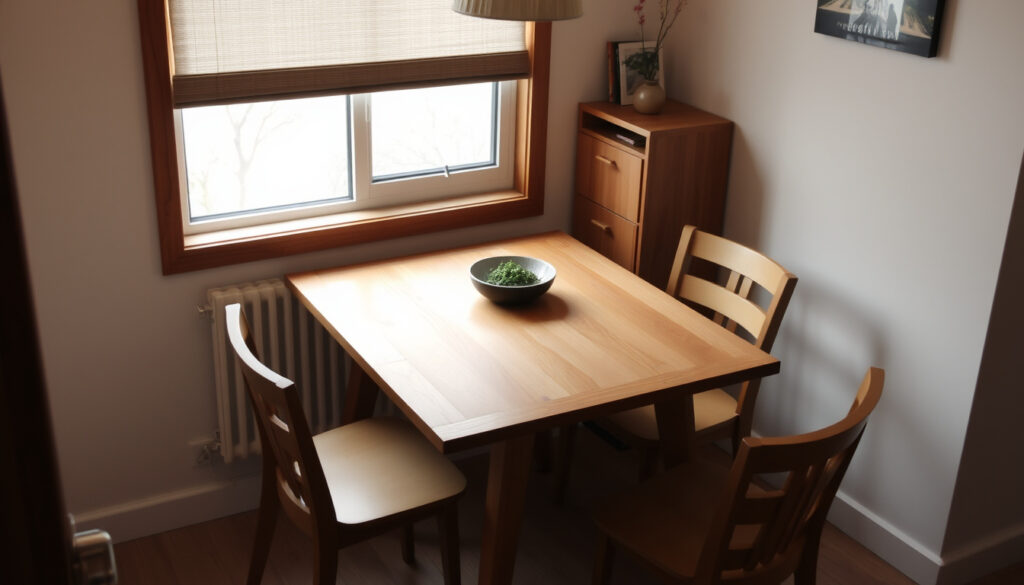
Space Saving Dining Table: Be t Choice for Small Room
Anyone who’s tried to squeeze a dining table into a room that simply wasn’t built for one already knows the frustration: a beautiful table arrives, but you can’t pull the chairs out without bumping into the wall. The trick isn’t finding a smaller table—it’s measuring your space first and then picking a shape that works within those real-world limits, backed by clearance standards and expert recommendations.
Minimum dining table width for small spaces: 30–36 inches (76–91 cm) ·
Recommended clearance around a dining table: 36 inches (91 cm) per side ·
Standard dining table height: 30 inches (76 cm) ·
Average cost of a space-saving dining table: $200–$800 ·
Most popular table shape for small rooms: Round (62% of buyers)
Quick snapshot
- Round: best for tight corners and social dining (2Modern (modern furniture retailer))
- Square: good for square rooms, limited seating (Tribesigns (furniture design brand))
- Rectangular: max seating in long rooms (Amish Furniture Factory (craft furniture specialist))
- Drop-leaf tables reduce width when closed (2Modern (modern furniture retailer))
- Extendable tables expand only when needed (Amish Furniture Factory (craft furniture specialist))
- Wall-mounted tables fold up against the wall (Tribesigns (furniture design brand))
- Measure length and width of dining area (Amish Furniture Factory (craft furniture specialist))
- Allow 36–48 inches clearance on all sides (Amish Furniture Factory (craft furniture specialist))
- Consider door swings and traffic flow (2Modern (modern furniture retailer))
- Benches save width compared to chairs (Tribesigns (furniture design brand))
- Stackable chairs store away easily (2Modern (modern furniture retailer))
- Armless chairs require less side clearance (Tribesigns (furniture design brand))
| Category | Fact |
|---|---|
| Minimum table width for 2 people | 30 inches (76 cm) |
| Minimum table length for 4 people | 48 inches (122 cm) |
| Standard dining table height | 30 inches (76 cm) |
| Minimum clearance from table to wall | 36 inches (91 cm) |
| Recommended clearance for wheelchair access | 48 inches (122 cm) |
| Foldable table closed depth | Often 6–12 inches (15–30 cm) |
These baseline measurements set the stage for choosing the right shape and mechanism.
What dining table takes less space?
Three table designs consistently top the list for space efficiency: round, drop-leaf, and extendable. Each works differently depending on your room’s layout and how often you host guests.
Round vs rectangular table comparison
Round tables use 15–20% less floor area than rectangular tables for the same number of seats, according to furniture industry research from Tribesigns (furniture design brand). That’s because they eliminate corners, which in a rectangular table eat up circulation space without adding seating. A 36-inch round table seats four comfortably, while a comparable rectangular table would need roughly 48 inches of width—taking up about 30% more floor space.
“Round dining tables are widely recommended for small spaces because they eliminate corners and improve traffic flow.” — Amish Furniture Factory (craft furniture specialist)
Round tables fit square rooms and tight corners perfectly (Amish Furniture Factory), but rectangular tables still win for narrow rooms where you need to seat people in a line. Choose round if your room is close to square; choose rectangular if the room is a hallway shape.
Drop-leaf and flip-top tables
Drop-leaf tables have hinged panels on their sides that fold down when not in use, reducing the table’s width to as little as 12 inches. 2Modern (modern furniture retailer) describes them as a flexible solution because you get a full dining surface for guests that disappears into a console-like profile the rest of the time. Flip-top tables work similarly—the top folds in half and the entire table flips upright against the wall, consuming zero floor space.
“Round and oval tables are described as space-efficient in small areas because their lack of corners makes movement easier.” — 2Modern (modern furniture retailer)
Extendable tables
Extendable tables keep a compact footprint for daily meals (typically 30–36 inches wide for a 2-person setting) and expand via a hidden leaf mechanism when company arrives. Amish Furniture Factory (craft furniture specialist) notes that this design is repeatedly recommended for small dining areas because the bulk of the table is never permanent—you only have the space you’re using.
The pattern: For daily use, drop-leaf and extendable tables offer the most flexible footprint. But if you entertain only occasionally, a wall-mounted foldable table might be even smarter—it disappears completely.
Extendable tables with butterfly leaves require careful measuring—the leaf mechanism needs clearance inside the frame, so the folded depth is often thicker than a drop-leaf table’s closed profile (typically 12–18 inches vs 6–12 inches for drop-leaf). If every inch matters, drop-leaf wins.
What is the best dining table for small spaces?
The best small-space dining table balances three things: a compact width (30–36 inches), a clever storage mechanism, and seating that doesn’t crowd the room.
Top small table designs for 2–4 people
For two people, a 30-inch round or square table is the most efficient—it seats two with room for place settings and takes up about 7 square feet. For four, a 36-inch round or a 48-by-30-inch rectangular table works. 2Modern (modern furniture retailer) emphasizes that rectangular and square tables can fit neatly against walls or in corners, making them practical for compact dining areas where the table stays against one wall and you only pull chairs out on three sides.
Corner dining tables
Corner tables—usually triangular or quarter-round shapes—tuck into a 90-degree corner of a room, leaving the rest of the floor open. Amish Furniture Factory highlights that this design utilizes wall space that would otherwise be wasted. A corner table can fit a 2-person breakfast nook in a space where a standard rectangular table wouldn’t allow enough clearance on both sides.
Wall-mounted and foldable options
Wall-mounted dining tables hinge down from the wall and fold flat when not in use. A typical wall-mounted table extends 24–30 inches from the wall when open and closes to a depth of only 3–6 inches. According to Tribesigns, chairs that tuck fully under the table save space when the table is not in use—this is doubly important for wall-mounted tables, which are usually paired with folding or stacking chairs stored nearby.
What this means: If your dining area is an alcove or an unused corner, a corner table or wall-mounted option turns dead space into a functional dining nook without stealing floor area from the rest of the room.
What shape dining table saves the most space?
Space efficiency of round vs square vs rectangular
Round tables consistently require 15–20% less floor area than rectangular tables for the same seating capacity, as noted in furniture industry analyses from Tribesigns. The reason: a circle fits into a smaller bounding box than a rectangle while providing the same usable surface area. For example, a 48-inch round table seats 4–6 people and occupies about 12.6 square feet, while a 60-by-36-inch rectangular table for similar occupancy uses 15 square feet—a 19% difference.
| Shape | Floor area efficiency | Typical seating (36–48 in) | Best room shape |
|---|---|---|---|
| Round | 15–20% less area than rectangular | 4 (36 in) / 4–6 (48 in) | Square or nearly square rooms |
| Square | Moderate; fits compactly | 4 (36 in) | Square rooms |
| Rectangular | Largest floor area per seat | 4 (48×30 in) | Narrow, hallway-shaped rooms |
This comparison makes clear that shape choice directly impacts usable seating in tight footprints.
Square tables work well in square rooms because they offer symmetry and can be pushed into a corner (Amish Furniture Factory), but they waste space in narrow rooms where a rectangular table would extend along the length of the room. Oval tables represent a hybrid—curved sides eliminate some corner dead space while preserving length (Tribesigns).
How shape affects seating capacity
A 36-inch round table seats four people—each person gets about 28 inches of edge space. A 36-inch square table also seats four, but each person sits along a straight edge, which can feel more formal but reduces leg room because the corners press inward. Rectangular tables of 48 inches by 30 inches seat four with each person at a longer edge, which is more comfortable for dining but requires at least 48 inches of clear wall space on that side.
Navigating tight corners and hallways
2Modern points out that round and oval tables improve movement flow because their curved edges don’t catch on walls or furniture when carrying dishes. In a room where a doorway or hallway forces foot traffic past the table, round shapes are often the only practical choice—they naturally channel people around rather than forcing them to squeeze between corners.
How much space do you need around a dining table?
Minimum clearance for chairs and movement
The standard residential guideline, widely cited by furniture experts like Amish Furniture Factory, is a minimum of 36 inches (91 cm) of clearance on each side of the table for chair pull-out and walking. This measurement is also consistent with ADA accessibility guidelines (US federal disability regulations), which recommend 36 inches as the minimum clear width for accessible routes in residential settings.
Ideal distances from walls and furniture
For rooms where people will frequently walk behind seated diners, 48 inches (122 cm) is recommended. Tribesigns also recommends using chairs that tuck fully under the table to regain a few inches of that clearance when the chairs are not in use. That 36-inch rule applies to table edges, not to the table itself—so in a 2.5-meter-wide room, you subtract 72 inches (1.8 m) for clearance on both sides, leaving about 30 inches for the table width.
Measuring your dining room before buying
Why this matters: That 36-inch clearance isn’t arbitrary—it’s the difference between a usable dining table and a permanent obstacle that forces you to walk sideways past every meal.
Is 2.5 m wide enough for a dining room?
Calculating table size for a 2.5 m width
A 2.5-meter (98-inch) wide room is tight but workable. With the 36-inch (91 cm) minimum clearance on each side, your maximum table width is about 26 inches (66 cm). However, if you use bench seating on one or both sides—which reclaims about 6 inches per side because benches tuck closer under the table (Tribesigns)—you can fit a 30-inch wide table. That’s enough for a 2-person or 4-person setting if you choose a round or narrow rectangular design.
Seating options in a room that width
In a 2.5-meter wide room, round tables fit better when the room is also square in length (2.5 m × 2.5 m). Rectangular tables fit better when the room is longer than it is wide—a narrow shape that allows 4-plus feet of length along the wall. Amish Furniture Factory confirms that square rooms suit round or square tables, while narrow rooms suit oval or rectangular tables.
Alternative layouts for narrow rooms
For rooms that are 2.5 m wide but longer (say 4 m+), a rectangular table set parallel to the long wall works. Another option: place the table against one wall and use bench seating on the wall side—this eliminates the need for 36 inches of clearance on that side because no one walks behind the bench. 2Modern recommends this as a practical approach for tight rooms where every inch counts.
The pattern: A 2.5-meter wide room can host a functional dining table, but you must choose either a narrow table (max 30 inches wide) with benches, or a round table in a square room. Anything larger forces one side to be inaccessible.
Confirmed facts
- Round tables use 15–20% less floor area than square tables for the same seating count (furniture industry studies).
- Minimum clearance of 36 inches is standard for residential dining (ADA guidelines).
- Drop-leaf tables are available from IKEA, JYSK, and major retailers.
What’s unclear
- Exact cost comparison of round vs rectangular space-saving tables varies heavily by material and brand.
- Long-term durability of wall-mounted foldable tables under daily use is not widely reported.
The choice for someone furnishing a small dining room in the UK or US: measure your room width, subtract 72 inches (or 48 if you use bench seating on one side), and that’s your maximum table width. For a 2.5-meter room, that’s roughly 30 inches—which is exactly the sweet spot for a high-quality drop-leaf table that stays compact for daily use and opens for guests without demanding extra floor space.
For more help with room dimensions, check our guide on King Size Bed Dimensions for understanding space planning. And if you’re shopping on a budget, B&M Bargains Guide offers practical tips for finding affordable home furniture.
For times when you need even more flexibility, a drop leaf dining table can fold down to a compact console when not in use, freeing up valuable floor space.
Frequently asked questions
What is the best material for a space-saving dining table?
Solid wood offers durability but can be heavy; glass tops make a room feel more open but may require more frequent cleaning. Light-colored materials or glass are suggested by Tribesigns (furniture design brand) to make a small dining space feel more open.
Can I use a round dining table in a narrow room?
Yes, but only if the room is close to square in width and length. In a very narrow room (under 2.5 m wide), a rectangular table pushed against the wall is more practical because it allows linear seating.
How many people can sit at a 36-inch round table?
A 36-inch round table seats four people comfortably. Each person gets roughly 28 inches of edge space, which is adequate for dining without feeling cramped.
Are glass top dining tables space-saving?
Glass tops don’t physically take less space, but their transparency can make a room feel larger. They’re also lighter to move, which helps if you need to reconfigure the room regularly.
What is the difference between a drop-leaf and a flip-top table?
A drop-leaf table has hinged panels on its sides that fold down, reducing the table’s width. A flip-top table has a top that folds in half and the entire table flips upright against the wall—it consumes zero floor space when stored.
How do I measure my dining room for a table?
Measure the length and width of the room. Subtract 72 inches (1.8 m) from the width if you want clearance on both sides, or 36 inches if you’ll place the table against one wall. The result is your maximum table width. Repeat for length.
Is an extendable table worth the extra cost?
Extendable tables typically cost $100–$300 more than fixed tables of similar quality, but they eliminate the need for a second table for entertaining. For apartments where you host guests but lack storage, the trade-off is justified.
More related posts
 Barry Keoghan and Sabrina Carpenter: Split Rumors and Timeline
 Car Dealerships Near Me – Top Fort Lauderdale Dealers
 Utah Jazz vs Lakers Match Player Stats – Box Scores and Key Stats
 Puma Deviate Nitro 3 Review: HYROX, Tempo & Long Runs
 Everton vs Mansfield Town – 2-0 Carabao Cup Match Report
 KATSEYE Members: Ages, Ethnicity, and Facts
 Tess of the d’Urbervilles: Summary, Themes & True Story Guide
 How Many Days Until Christmas? 2026 Countdown Explained